
Discipline Policy
Melville-Knox Christian School Glasgow Discipline Policy
1. Policy Statement
The most important aspect of a Christian education is the shaping of godly character within the pupil. The Bible says: “For whom the LORD loves He chastens, and scourges every son whom He receives.” (Hebrews 12:6). From beginning to end, it is clear in God’s word that training and correction are acts of love. All corrective measures should have the goal of reaching the heart of the pupil. MELVILLE-KNOX CHRISTIAN SCHOOL faculty and staff approach correction and discipline from this perspective. Each case will be judged individually with the teachers striving to balance justice and mercy for the good of the pupil. If a pupil receives discipline from step 4 upwards, a note or phone call will ensue to keep parents informed.
A copy of this policy is to be given to all prospective pupils and their parents/carers. The aspects of this policy will be explained to the prospective parents, if required, by teachers when parents are interviewed.
2. Standard of Expected Conduct
A Melville-Knox Christian School Pupil is expected to behave in a manner that exhibits the following characteristics:
- Cheerful, immediate obedience to authority and adherence to school regulations even when a person in authority is not present.
- Responsibility in fulfilling and assignments and expected tasks.
- Cooperation with others in playing and working at school.
- Courtesy and respect for others, such as being quiet in hallways, not interrupting others, walking (not running) in buildings and eating with proper manners.
- Cleanliness in person and property. Pupils should put rubbish into rubbish bins, pick up paper on the floor and grounds, keep their desks neat and dress neatly and cleanly (and where uniform is required wear the uniform according to the described standards)
- Being truthful in word and deed, in all circumstances.
- Showing respect for the property of the school and other people.
- Morally upright conduct in all areas of life, including language, social relationships and recreation.
- Respect for God which is demonstrated in part by displaying the characteristics listed above.
The following behaviour is considered foolish, potentially dangerous and/or disruptive and is prohibited. This list is not exhaustive, therefore actions not included here may also be considered equally foolish/potentially dangerous and/or disruptive.
- Stealing or intentionally damaging or attempting to damage property.
- Threatening or joking about endangering or attempting to endanger any person or damaging/attempting to damage any property.
- Cheating on any school work. This activity includes attempting to copy another’s work or attempting to use prohibited notes or reference materials.
- Possession or use of cigarette lighters, tobacco products or alcoholic beverages.
- Failing to reveal (when requested by any school staff) the contents of a bag or container or contents of an article of clothing under the pupil’s control on school property.
- Fighting which is considered to be intentionally attempting to cause or intentionally causing any person physical pain without justification (sports, self-defence and defence of another are at times considered execeptions).
- Making intentional physical contact of an innapropriate nature.
- Accessing or possessing material that is determined to be pornographic.
- Violating the uniform code after the initial warning.
- Failing to submit to discipline.
3. Discipline Procedure
The kind and amount of discipline will be determined by the teacher(s) and if necessary, the head teacher and parents. The discipline will be administered in light of the individual pupil’s problem and attitude. All discipline will be based on biblical principles: restitution, apologies (public and private), immediate and instructive punishment, restoration of fellowship, no lingering sinful attitudes, parental involvement etc. The vast majority of discipline problems are to be dealt with at the classroom level. As in all other areas of the education at MELVILLE-KNOX CHRISTIAN SCHOOL, love and forgiveness will be an integral part of the discipline of a pupil. It is important also for parents and teachers to work in coordination with the head teacher to identify causal factors contributing to pupil behaviours not conducive to learning.
The flip side of the coin in discipline is rewarding pupils. In this, we model our Heavenly Father who disciplines out of love and rewards out of love. Occasions for rewarding individual children verbally and other ways should be constantly sought. This will build up the pupils’ self-confidence, their feeling of self-worth and motivate them to keep up the good work. It will also serve as giving other children examples to follow. However, teachers should be aware of any undue favouritism and aim to reward good behaviour in all children.
The following steps of discipline act as a guideline to teachers who aim to build steady standards for constructive discipline:
- Verbal warning, correction or rebuke.
- Use of traffic lights (after warning has been given)
- Denial of privileges, including changing seating arrangements.
- Reflection on behaviour using dialogue and reflection sheets.
- Assignment of extra (constructive) work.
- Removing the pupil from the classroom.
- Sending the pupil to the head teacher or other teacher for a talk.
- Parental involvement.
Temporary suspensions and final expulsions from the school should be avoided and only used as a very last resort, in cases where a pupil’s behaviour shows no improvement and is constantly disturbing other pupils.
As with discipline, rewarding is to be administered fairly and in increasing steps. It is recommended that class teachers will have a reward chart where pupils who have done their work well and behave well, will be rewarded. The following are guidelines for rewarding:
- Verbal praise (to be given often and freely).
- Points on the reward chart.
- Item from the prize box.
- Granting privileges.
- Mention of excellent behaviour and work in the report card.
Teachers should aim to keep parents informed of their child’s good behaviour or work from time to time.
4. Bullying
Everyone who attends the school has the right to feel safe and happy. Any behaviour which undermines that right is unacceptable. The school operates a policy of zero tolerance to bullying. Teachers / assistants / mentors will act promptly and firmly to deal with such behaviour.
Bullying is a wilful, conscious behaviour where the victim is subjected to physical, psychological or verbal abuse by an individual or group of individuals who are aware of the distress being caused. This behaviour is usually repeated over a period of time. A fight between two individuals of similar size and strength may not be bullying.
The school recognises that the perpetrator/s bear responsibility for bullying and no fault is to be sought in the victim/s of bullying. All bullying is unloving and hence in opposition to Christian teaching of loving one’s neighbour. In all cases of bullying, the perpetrator/s need/s to confess and ask for forgiveness from the victim/s to ensure the seriousness of his/her act is acknowledged. Further incidents of bullying in spite of warning and immediate discipline will trigger further discipline procedures, as described in the Discipline Policy of the school, in particular the involvement of parents of all parties, including both the perpetrator/s’ and of victim/s’.
All bullying is an abuse of power. It includes many different types of behaviour. The following are examples which are considered unacceptable.
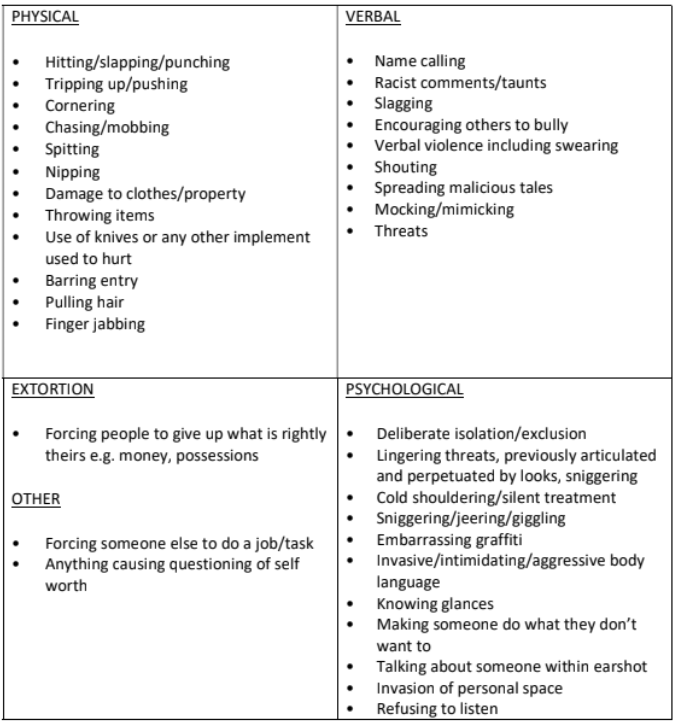
4.1 Possible Signs of bullying
- Extreme tiredness
- Change in personality
- Loss of weight
- Continual “losing” of money
- Refusal to say what is wrong
- Social isolation
- Beginning to stammer
- Frequent loss or spoiling of possessions
- Unexplained cuts or bruises
- Non-attendance
4.2 Effects of bullying
- Loss of self esteem
- Mistrust of peers, teachers, family
- Feeling powerless and emptiness
- Change of personality
- Exclusion from social groups, rejection, isolation
- Extreme misery and in extreme cases, suicide
4.3 Procedure for dealing with cases of bullying
All parties in the school are to be encouraged to report cases of bullying, including teachers, assistants and other staff, parents and children themselves. The school’s policy of zero tolerance to bullying will be made clear in the school assemblies, at parents’ nights and in the school’s every day teaching of Christian values of love and respect of all. If bullying is reported, the following procedure is to be followed:
4.3.1 Teacher / head teacher will talk privately with both parties separately, trying to establish what happened and what had been said.
4.3.2. If it is established bullying has taken place, the perpetrator/s will be rebuked for their action and asked to repent and to apologise to the victim/s. Whether this is done in private or in public, will be decided by the teacher / head teacher in charge. Notes on the incident will be recorded in a behaviour log to assist teachers in tracking behaviour problems.
4.3.3. The victim is encouraged to grant forgiveness and reconciliation will be sought.
4.3.4. If deemed necessary, the victim will receive further support from the staff to ensure the hurt caused by the incident/s is healing and that the victim feels appreciated and accepted in the school.
4.3.5. If the bully does not show a change of behaviour and continues bullying either the same victim/s or other/s, further discipline procedures will be followed, as laid out in the Discipline Policy, and parents of all parties are engaged in the process.
5. Right to Complain
Parents who think their child has been unjustly disciplined should first talk to the head teacher regarding their complaint and, should they wish, then lodge a formal complaint (see Complaint Policy for further details).
The policy will be reviewed annually. The next review date for this document is June 2026.